
Comfort-Based Mobility Assistance
Traditional accessibility often ignores the human experience, focusing only on time, distance, and costs. Comfort-based accessibility tools, like CAT, redefine urban planning by integrating environmental, physical, and psychological factors into spatial analysis. By visualizing how discomfort, such as noise, steep slopes, or lack of shade, shrinks the reachable area for different individuals, these technologies highlight invisible barriers. They serve as essential decision-support systems, helping planners design more empathetic, inclusive, and equitable cities where movement is defined by well-being rather than just proximity.
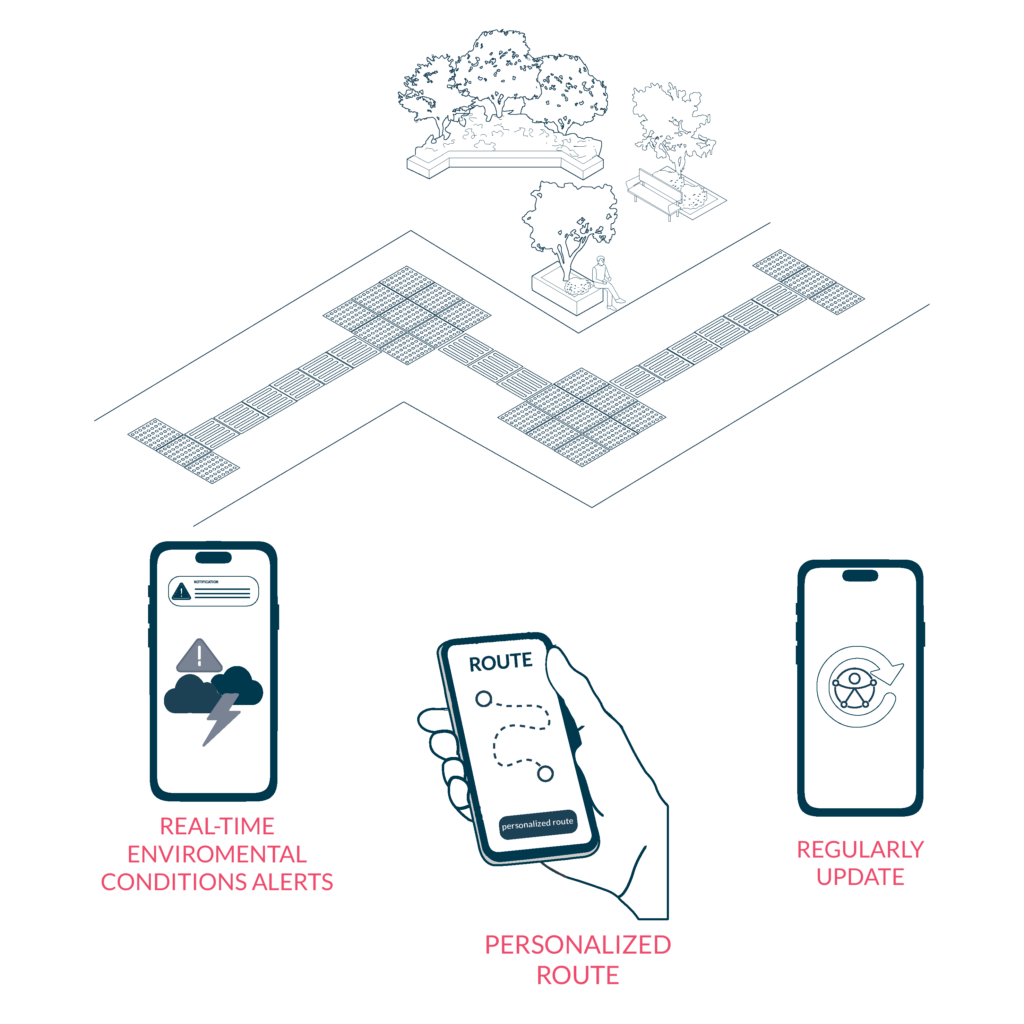
- Incorporate Group Profiles: Use predefined profiles to help professionals simulate the challenges faced by different vulnerable social groups
- Empower User Personalization: Allow individuals to adjust parameters like speed and sensitivities to reflect their unique needs.
- Prioritize Intuitive Interfaces: Use standardized icons and clear onboarding to reduce the learning curve for non-specialists.
- Ensure Data Transparency: Clearly communicate data sources to build trust among experts and the public.
Sources
- https://accessible-eu-centre.ec.europa.eu/content-corner/digital-library/en-172102021-accessibility-and-usability-built-environment-functional-requirements_en
- https://www.access-board.gov/adaag-1991-2002.html#2.%20GENERAL
- https://universaldesign.ie/built-environment/building-for-everyone/building-for-everyone-full-series
- https://www.codigotecnico.org/pdf/Documentos/SUA/DccSUA.pdf
- https://inclusive-space.vercel.app/el/