
Healthy Indoor Air
Designing healthy and inclusive indoor spaces is essential for promoting well-being, ensuring a comfortable, safe, and sustainable environment for all individuals. Maintaining high indoor air quality, regulating humidity, and considering the local environmental context are crucial elements in achieving these goals.
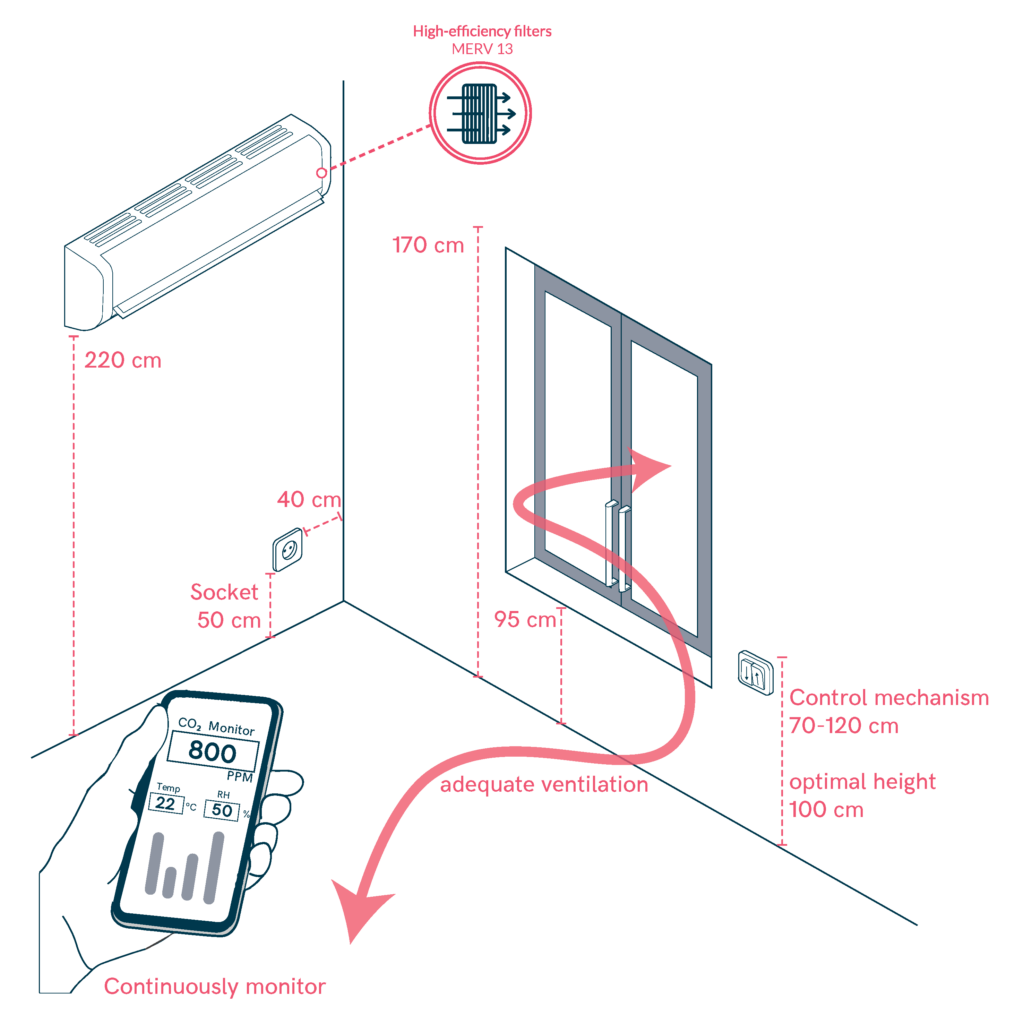
- Ensure adequate ventilation in all rooms to maintain air quality and comfort.
- Design windows that open to be easily accessible and controllable by building users.
- Regularly maintain mechanical ventilation and air-conditioning systems for maximum effectiveness and noise reduction.
- Install high-efficiency filters (MERV 13 or higher) in ventilation systems to ensure clean air.
- Continuously monitor indoor air quality, tracking CO2, particulates, and VOCs to maintain a healthy environment.
- Regulate indoor humidity levels to prevent mold growth and moisture-related problems.
- Customize ventilation systems to local pollution conditions to optimize air quality and reduce health risks.
Sources
- https://accessible-eu-centre.ec.europa.eu/content-corner/digital-library/en-172102021-accessibility-and-usability-built-environment-functional-requirements_en
- https://breeam.es/
- https://www.usgbc.org/leed
- https://evalore.es/servicio/certificaciones-medioambientales/
- https://www.codigotecnico.org/pdf/Documentos/SUA/DccSUA.pdf
- https://universaldesign.ie/built-environment/building-for-everyone/building-for-everyone-full-series