Dear legislators and regulatory technicians,
Efficient access to regulations, manuals, and reference cases is essential when designing or adapting spaces, as it ensures the proper implementation of solutions and improvements applicable to our built environments. Today, there are numerous manuals and regulations, some specialising in very specific topics, while others are more general, all of which can serve as valuable reference tools. However, the diversity of these resources and the lack of a unified system for consultation make access difficult, potentially limiting their effective use.
The most important task is not to continuously generate new regulations, but rather to organise and structure existing knowledge effectively. This tool proposes the creation of an organised repository that groups together these regulations, manuals, and reference cases, allowing designers, planners, and users to access information quickly and efficiently. This repository aims to be easy to consult, with a clear index and a glossary of terms to facilitate navigation and the implementation of inclusive solutions in space design.
Establishing a well-structured consultation system not only optimises the application of best practices but also contributes to building collective and shared knowledge about inclusion in the built environment. Moreover, a well-organised system promotes a common and coherent vision, ensuring that proposed solutions are applicable in diverse contexts, respecting both global standards and local particularities.
Recommendations for public policy:
For Universal Design to move beyond good intentions and become a tangible reality in our environments, it is essential that the regulatory framework evolves. We propose a set of strategic recommendations aimed at transforming the current regulatory landscape—often perceived as rigid and overly technical—into a dynamic driver of inclusion.
Our approach is structured around five key pillars: the development of accessible and coherent legislation; the expansion of the scope of inclusion and accessibility through practical tools, to reflect the full diversity of human experience; the integration of future challenges—such as demographic change and digital transformation—into regulatory thinking; the establishment of a shared and clearly defined language and terminology; and the active involvement of future users in co-design processes.
Our aim is to provide tools that enable the creation of standards that not only establish minimum requirements but inspire genuinely inclusive and adaptable solutions capable of responding to the diversity of all people.

Accesible & Coherent legislation
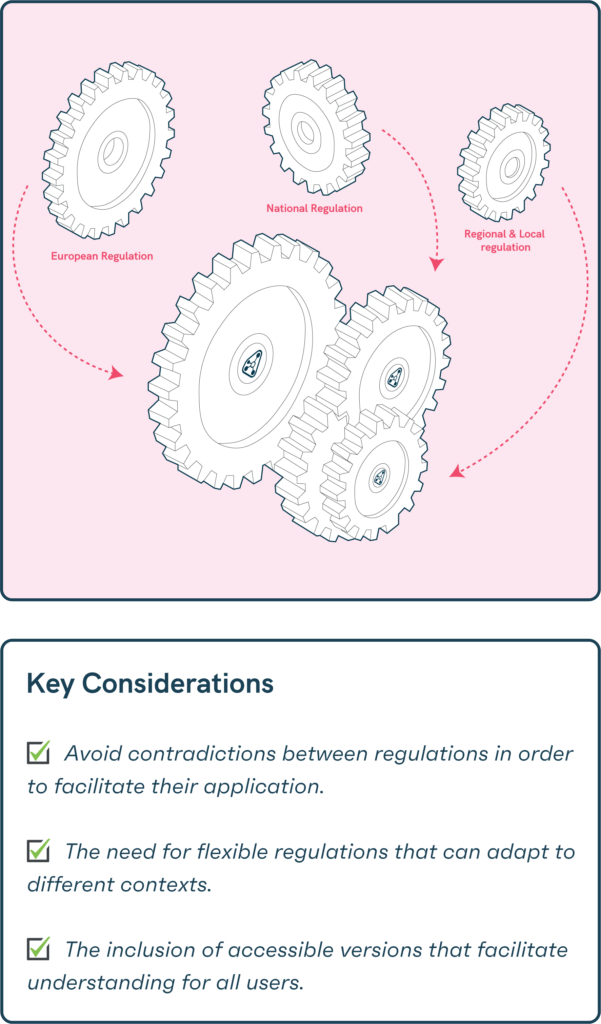
As a result of the analysis carried out using the various sources included in this tool, we have identified a series of common conclusions directly related to the type of regulations studied. The first concerns the application of regulations and certifications in the built environment. Regulations should be understood and applied in an integrated manner across all territorial scales, from the international level to the European, national, regional and local levels. Since all regulations are mandatory and their impact does not have clear boundaries, efforts should focus on achieving coherence and complementarity. To this end, administrations should align under a regulatory hierarchy that allows local adaptations and developments while maintaining a unified framework.
In many cases, in order to establish clear parameters, regulations impose restrictions that complicate their development or integration with other regulatory frameworks at different administrative levels. Regulatory compatibility not only means that different documents can coexist without conflicts, but also that they can adapt to changing contexts without losing coherence. It is essential that regulations are not interpreted as immovable structures, but rather as flexible tools that facilitate the implementation of solutions rather than obstructing them. When regulations are complementary rather than exclusionary, they enable the development of more comprehensive solutions better adapted to real needs.
To achieve this objective, it is necessary to foster continuous dialogue between the different public administrations involved in the development and implementation of accessibility and inclusivity regulations in the built environment, in order to avoid contradictions or rigidities that hinder their application. This would enable the integration and continuity of accessible and inclusive spaces without interruptions for users across all areas of our built environments. Such alignment should be pursued as an essential objective, guaranteeing the right to carry out the basic activities of daily life (living, working, moving and orientating oneself) autonomously.
Furthermore, it is useful to analyse examples from other countries and apply their outcomes at regional or national level. In many cases, other territories have developed more advanced regulations that could serve as references. However, despite the many differences and contradictions in the adoption of regulations in different places, it is possible to identify good practices and apply them in an adapted way. Finally, although regulations must be technical texts defined for their proper application, it is crucial to provide accessible versions (easy to find, free of charge, readable and understandable, etc.) that facilitate comprehension both for municipal technicians and for professionals, future users and people with disabilities.

Expanding the Scope of Inclusion and Accessibility Through Practical Tools
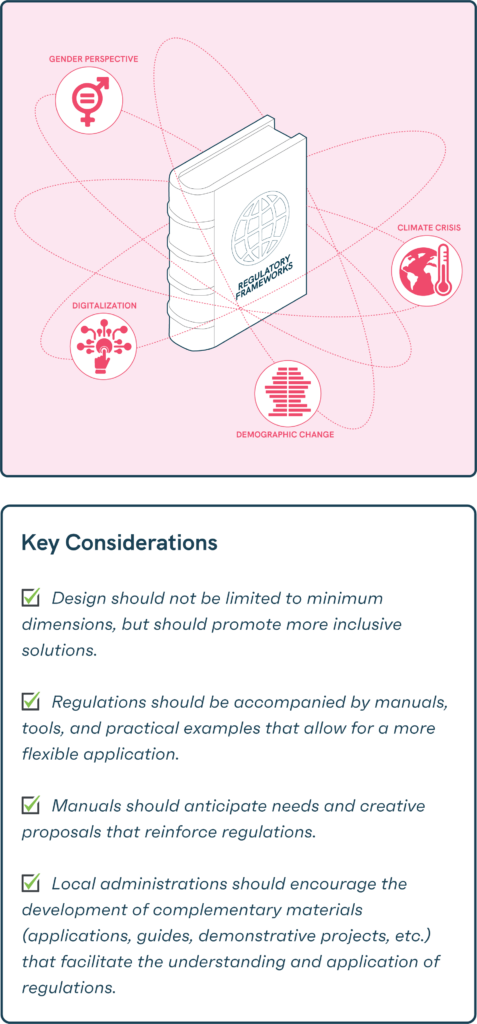
Regulations provide an essential framework for the planning and execution of projects. However, the reality of many projects often requires solutions that go beyond what is strictly defined. In such cases, tools such as specialised manuals, technical guidelines, and pilot projects come into play, allowing experimentation with new methodologies and approaches, expanding existing concepts of accessibility and inclusion without being limited by prescriptive regulatory frameworks. Manuals and other documents produced by associations and social organisations linked to people with specific needs and vulnerabilities, in particular, can anticipate issues and requirements that have not yet been incorporated into regulations, offering innovative ideas for future developments. These documents and projects provide greater flexibility to adapt to specific contexts, addressing aspects that are not yet covered by general regulations.
For example, existing regulations often include drawings with minimum dimensions that must be met, which leads many designers to settle for the minimum standard rather than opting for a more spacious and adaptable design. For this reason, it is important that the drawings included in regulations are clearer and do not merely depict the minimum required dimensions. In many cases, this approach results in designers adopting the bare minimum to comply with the regulations, limiting the potential to create more inclusive and adaptable spaces. The broader and more flexible the established dimensions, the greater the ability of projects to meet the needs of a diverse range of users, thereby promoting more accessible and equitable environments.
It is essential that regulations are updated, not only through direct revision, but also by studying real projects and manuals that depart from conventional applications of the rules. These sources can offer innovative ideas and anticipate new needs that have not yet been considered in the legislation. Manuals should be understood as a complement to regulations, enriching and expanding their scope without contradicting the rules, while enhancing their application and adaptability. An effective approach would be to develop practical manuals and tools (applications, guides, demonstrative projects, etc.), accompanied by examples and illustrations, which not only demonstrate how to comply with regulations, but also suggest creative alternatives that extend the scope of action for projects. These manuals should be developed in collaboration with the relevant authorities and adapted to local needs, ensuring that the proposed solutions are appropriate for specific contexts. Ultimately, these materials should serve as prototypes for future regulatory changes, facilitating a more flexible and dynamic application of regulations in real-world projects. Such tools help bring the technical complexity of regulations closer to end users, empowering the population through knowledge of existing regulations and enabling them to claim their rights in the built environment.

Integration of future challenges
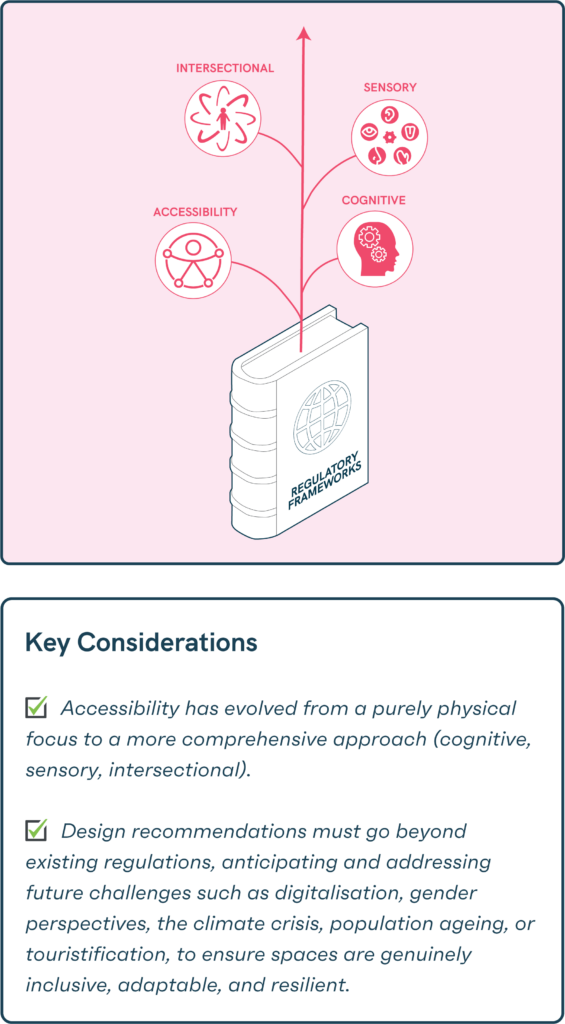
As with all legislation, regulations are in a constant state of evolution and, therefore, require periodic updates to incorporate present and future challenges faced by Western societies: population ageing, increasing digitalisation, the integration of a gender perspective, the climate crisis, the touristification of historic areas, and other urban phenomena affecting our cities.
Originally, traditional documents focused primarily on accessibility for wheelchair users. Over time, other forms of accessibility, such as cognitive and sensory accessibility, have been integrated. More recent approaches also incorporate a gender perspective and environmental considerations, expanding the framework of inclusive design. The most recent examples of inclusion go even further, considering people whose circumstances may create similar or entirely new access barriers beyond the traditional theoretical framework of accessibility. This includes not only people with disabilities but also those who, due to factors such as gender, ethnicity, age, or other intersectional aspects, face difficulties navigating the built environment. The diversity of these users and the overlap of different exclusion factors have driven a more inclusive perspective in design, enabling spaces to better respond to the realities of all people.
In some of the case studies and interviews analysed, accessibility is now being understood in broader terms. For example, ramps are increasingly recognised not only as beneficial for wheelchair users but also for travellers with luggage. Similarly, changing rooms are being designed to accommodate those who require assistance, ensuring adequate space. It is also acknowledged that two wheelchair users may attend an event together and, therefore, should have the right to share the experience in a designated space. Moreover, the perception of wheelchair users is changing: they are no longer seen solely as care recipients but also as caregivers. Ultimately, the representation of people with disabilities is evolving, not only as individuals or accompanied by a carer, but as active members of the community, experiencing cities and spaces collectively.
Shared and clearly defined language and terminology
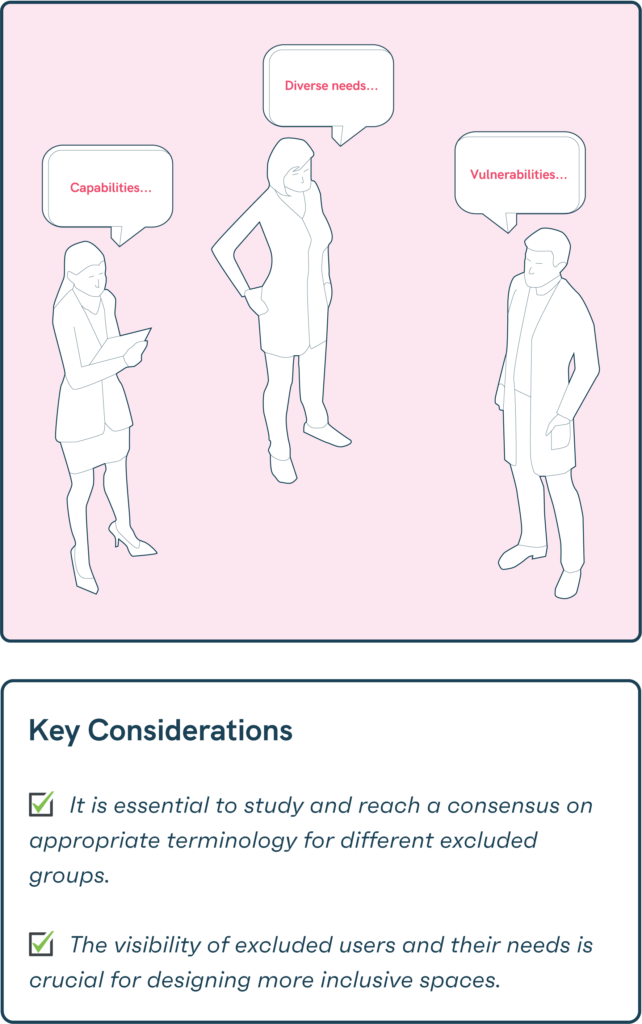
Terminology in inclusion remains a constant challenge, as it defines and makes excluded users visible. The divergence in words and conceptual approaches constitutes an ongoing challenge in the field of inclusion. To address this issue, it is essential to examine which users are currently excluded from spaces and how to refer to them appropriately. In some cases, certain terms may be problematic or inadequate, while in others they may be precise and relevant.
The adoption of specific terminology must be justified and argued at some point in the process, but it should also emerge from a consensus among all stakeholders involved. This divergence of concepts is, in fact, an enriching factor that fosters an ongoing conversation, gradually incorporating new categories and more diverse, inclusive, and comprehensive approaches. Since achieving such consensus is a complex task, it is crucial to provide a theoretical or conceptual framework (glossary, shared terminology, definitions, etc.) to support any project, manual, regulation, or other proposal. This ensures that anyone consulting the text or experiencing a space can understand the rationale behind its creation. Establishing a shared terminology and approach means making users visible collectively. Making these users visible also highlights their needs and, consequently, the current level of inclusion within public and virtual spaces. When assessing the inclusivity of a space, both its accessibility and functionality, as well as its shortcomings and barriers, become evident. Ultimately, it is the spaces themselves that are either equipped or unequipped to accommodate the diversity of the world and must adapt accordingly.

Involvement of future users in co-design processes
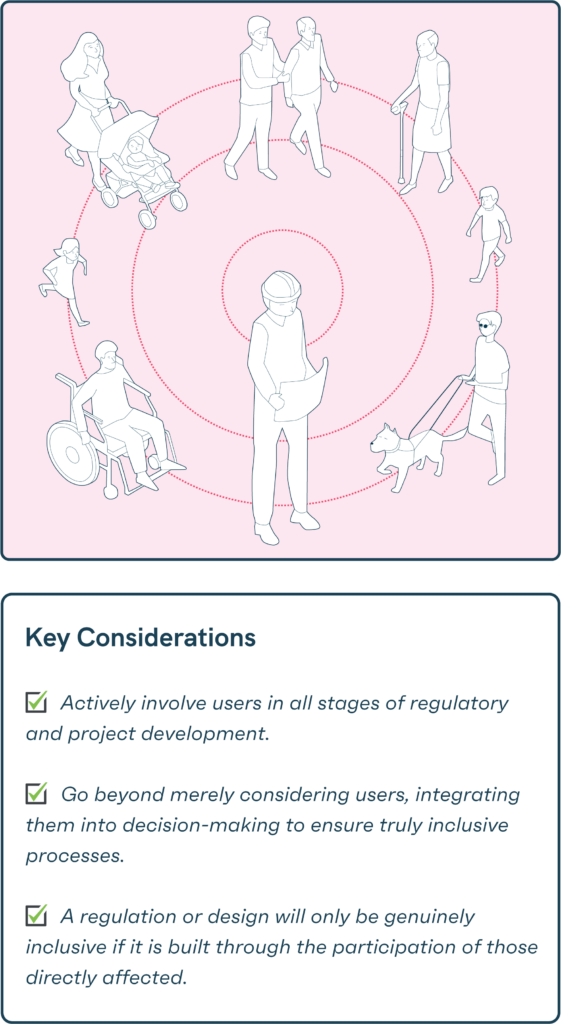
People with disabilities are not only inhabitants of the city, but can also contribute as designers of the urban environment. To facilitate this, it is necessary to develop accessible design processes and adapt regulatory documents. Regulations are often designed solely for technical consultation, making them difficult for the general public to understand. Without the necessary specialised training, society is at a disadvantage in comprehending them and, consequently, in influencing their modification through suggestions or new measures.
Incorporating end users of built environment projects and designs into participatory processes is one of the most significant actions for improving inclusion and, consequently, people’s quality of life. Beyond specific measures, the key lies in how these processes are designed and structured, ensuring they are truly accessible and representative. Involving people with disabilities in the regulatory design process would be a crucial step to ensure more inclusive and adaptable standards.
In other words, what matters is not just the outcomes but how they are achieved. This means that participants should not merely be recipients of decisions, but key actors throughout all stages of development: from conception and design to implementation and evaluation of projects, regulations, and policies. Their active involvement is essential to ensure that regulations, manuals, technologies, and projects genuinely respond to their needs and contexts.
User participation must be an integral part of the design process. It is not enough simply to consider users; their lived experiences must be incorporated to test, validate, and improve proposed solutions. Ultimately, any regulation or project that aims to be inclusive must be built through the participation of those who will be directly affected.
Furthermore, there should be publicly accessible documents that allow for broader participation, whether through public consultations or participatory workshops. Interestingly, these accessible documents might be preferred by many architects, as they could simplify the interpretation and application of regulations. Finally, it is important to consider that technical professionals (architects, urban planners) may also face difficulties in interpreting regulations, and in some cases, cognitive disabilities could limit their professional autonomy. Although this aspect may not constitute a central focus of the project, it could be regarded as a relevant dimension. Ensuring genuine inclusion in design and regulatory processes is essential, and parallel mechanisms could be established to support it.